Want your classic to handle like the latest from Ducati or
Honda? That might be putting the bar a little too high, but you can
dramatically improve the handling of your vintage ride, particularly if it’s
from the Seventies and Eighties, with some comprehensive upgrades.
Compared to modern bikes, vintage motorcycles typically have
pretty unsophisticated suspensions. During the 1970s, engine power — and by
default top-end speed — developed at an accelerated rate, yet suspension
improvements were slow in coming.
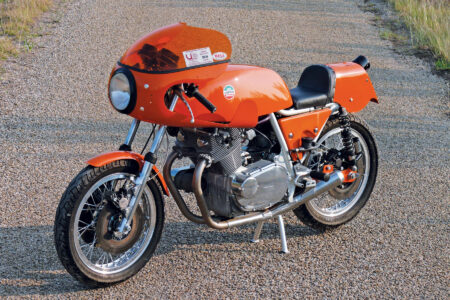
My 1983 Laverda RGS1000 is a prime example of this. With
something like 75 rear-wheel horsepower on tap the Laverda isn’t exactly a
powerhouse by modern standards. But it’s not exactly slow, capable of
125mph-plus speeds and quarter-mile sprints in the mid 12-second range.
Unfortunately, the Laverda’s chassis isn’t quite up to its powertrain. Soft
springs and poor damping allied with high friction forks leave the front end
with a bad tendency to pogo, especially on small, repetitive bumps. The rear
has the same buckboard characteristics, courtesy of a pair of vintage Konis,
replacements for the original and notoriously poor-performing air-charged
piggyback Marzocchis.
The heart of the problem
I can deal with less than ideal suspension on a bike I only
ride a few miles every now and then, but I like to take the Laverda on all-day
500-mile jaunts, and the poor suspension was starting to blunt my enjoyment.
Looking for a solution, I put the issue to Matt Wiley, the vintage go-to guy at
suspension specialists Race Tech. A fixture at vintage-ride race
events around the country, where he helps racers sort their suspension woes,
Matt has earned a justifiable reputation for knowing how to make old
suspensions perform well.
The problem, according to Matt, is simply one of technology.
The Laverda has 38mm Marzocchi damping rod-style forks typical of the 1970s and
1980s. Damping rod forks are limited in performance and ride quality due to
their simple orifice-type damping, where a series of holes control oil flow for
damping. And despite the fact that road bumps — and riders — come in all shapes
and sizes, the orifices are fixed in size and number, resulting in wide
variations in fork compression speed. This is single-stage damping, with one
damping rate for all situations. But for proper performance and comfort you
need dual-stage, high and low speed damping — and adjustability is a nice plus.
Further, where modern fork legs are hard-anodized to reduce
friction between the fork tube and the slider, the Laverda’s sliders are just
machined aluminum alloy, typical of the era. And without a bushing carrying the
load the sliders work directly against the tubes, shedding aluminum into the
fork oil as they move up and down the hard chrome fork tubes. That wear shows
up as dirty, gray/black fork oil, contaminated with aluminum oxide worn from
the sliders. It becomes something of a feedback loop, with wear accelerated by
the increase of aluminum oxide in the oil, further contaminating the oil.
And where modern rear shocks come with a variety of
compression and rebound adjustment options, vintage shocks are typically
preload adjustable only, leaving pretty much zero tuning options. Leaning on
Matt’s expertise, I assessed my options for updating the Laverda’s suspension.
Getting to it
Since I use the Laverda regularly as a commuter and a road
bike, Matt encouraged a comprehensive approach, with a complete front end
rebuild and a set of modern shocks at the rear.
Following Matt’s advice, I started with having the sliders
hard-anodized, an electroplating process that coats every square inch of the
slider. Anodizing changes the crystal structure of the metal, increasing the
thickness of the oxide layer at the surface. This leaves the inside smooth and
slick, while the outside takes on a matte black finish. I wanted to keep the
original powder-coated, gloss black appearance of the sliders, so with Matt’s
help we went an extra step and “show polished” the sliders — which I had
already stripped, media blasted and polished — prior to anodizing. After hard
anodizing we stripped the outside of the sliders and had them powder-coated.
Even if you only anodize the sliders, Matt says the cleaner and more polished
they are before anodizing the better they’ll look when done.
To give my forks dual-stage tunable damping we installed
Race Tech Gold Valve Cartridge Emulators. The emulators control low-speed
compression damping via bleed ports in the valve plate. An adjustable spring on
the main valve controls high-speed compression. This adjustment lets you tune
out the “hit” you usually feel on sharp bumps with damping rod forks.
Depending upon the forks, installing the emulators requires
varying amounts of machine work to the damping rod, including drilling extra
bleed ports. Although we left this part to Matt, it can be done by competent
do-it-yourself types without having to send the forks to Race Tech. Some
applications (like the Laverda) require a special adapter to fit the emulator
to the damping rod, as well as new sealing rings for the damper rod pistons.
There are four valve spring rate options (ranging from soft
to hard), with a wide range of adjustment for each one. Once installed, the
emulators can usually be removed through the top of the fork for adjustment
simply by removing the fork cap and spring with the forks still on the bike.
Matt suggested softer springs for the Laverda (specifically, 40 pound “blue”
springs), noting it often takes a few adjustments of the spring preload to find
the “sweet spot.”
The emulator only controls compression damping. Rebound
damping is controlled by fork oil viscosity — the thicker the oil the slower
the rebound, the thinner the oil the faster the rebound. Matt says anything
from a 5wt to 30wt fork oil can be used to control spring action via rebound
damping. Further, the emulator valves can be adjusted to compensate for the
thicker oil viscosities often required for proper rebound damping with the
damping rod forks. We used Spectro brand 15wt fork oil, which Matt recommends
for vintage applications like the Laverda.
We also installed Race Tech fork springs, which must be used
with Gold Valve Emulators to meet spring length requirements and to ensure
proper spring rates. According to Matt, original equipment springs are
typically too long and too soft while dual-rate springs (which he doesn’t
recommend) are too long and too stiff. Assuming a 200-pound rider fully geared,
we went with Matt’s suggestion of 0.90kg straight-rate fork springs (the
springs compress 1mm for every 0.90kg of force) with moderate spring preload to
reduce brake dive and utilize more fork travel. These replaced the soft, high
preload 0.70kg stock springs, which sacrificed a lot of fork travel with just
the rider on the bike.
Pitted, chipping chrome on upper tubes is another source of
friction and deadly to fork seals. The RGS’ fork tubes were on the way out, so
we replaced them with Italian made TNK tubes. Available exclusively through
Race Tech, they’re exact replacements and excellent quality.
The other end
At the back, we swapped the tired set of Konis for Race Tech
G3-S shocks. Like all G3-S shocks, they were custom built to order with choice
of length, features, color, etc. Race Tech’s comprehensive build sheet includes
specs for extended and collapsed shock length, swingarm pivot to upper shock
mount and swingarm pivot to lower shock mount measurements, rider skill level,
intended use, and more.
Instead of bushings, the G3-S shocks feature spherical Heim
bearings at their mounting points to ensure the shocks don’t bind. They’re
preload adjustable and feature an internal floating piston that separates the
oil from the high-pressure nitrogen gas. For full tunability, we ordered our
G3-S shock with optional ride height and rebound adjusters. The 100 percent
U.S.-made shocks are, as you’d expect, a simple bolt-on replacement.
Adding it up
So what price glory? We did the full strip-down ourselves,
replacing steering head bearings while we were in there. Ignoring any labor
considerations, Race Tech charges $200 to hard anodize a set of disassembled
sliders, more if extra prep work is required. Powder coating added another
$200. The TNK fork tubes were $520 a set and the Gold Valve Emulator kit ran
$170. We also needed a pair of emulator adapters ($15) and damping rod piston
rings ($40). Then you can throw in fork springs ($125 a set), fork seals ($25 a
pair) and fork oil ($11 a quart). For the rear shocks, with optional ride
height and rebound adjustment and black anodized bodies (silver and black are
standard colors), the G3-S shocks were $850. Total all that up and our
conversion runs just over $2,200, a not inconsequential sum of money for most
of us.
But we went all-out on this project, with the polish,
anodizing and powder coating adding significantly to the fork costs. You might
not need or want those extras, and if the tubes had been OK it would have been
that much cheaper yet. A typical Race Tech vintage fork upgrade with Gold
Valves, custom rate fork springs, and wear/tear parts and labor starts at
around $500, with anodizing, powder coating and polishing extra. TNK fork tubes
vary in price by application, and G3-S shocks start at $599 a pair.
That may seem like a lot of money to put into your
suspension, but the payoff is huge. The updates we did completely transformed
the Laverda. At the front, damping is now controlled and predictable. Brake
dive has been mostly eliminated, rebound control is excellent and pogoing has
been rendered a thing of the past, all significantly improving rider
confidence. Getting there required only one round of adjustment, which involved
dialing the springs on the emulator valves to a slightly softer setting.
And where the rear wheel used to literally hop and skip
across road irregularities it’s now absolutely planted. I played with adjusting
the rebound, but went back to the initial setting, which is dead in the middle
of its range. Frankly, it’s almost hard to believe that simply bolting on a
pair of quality shocks can make such an enormous difference.
The ride quality is now excellent, and the increase in
contact and control front and rear has made the Laverda so much more
satisfying. It now rides and performs the way I always wanted it to, but
clearly couldn’t because of inherent limitations in suspension design and
function. Is it worth the expense? Absolutely. If you ride a lot and want a lot
out of your classic, upgrading your suspension is some of the best money you’ll
ever spend. MC